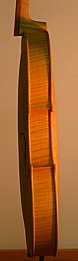
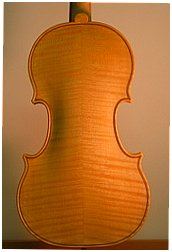
After developing a beautiful tan, it is time for “The Lyric” to get a bath. This is the aqueous phase of the ground preparation. The first step is to apply a coat of a 3% gelatin solution. I do this to seal the end-grain in order to prevent uneven absorption of the stain color. Next I apply a water based stain to the whole violin. This enhances the contrast between the winter and summer grain a gives the instrument a nice orange/cinnamon color. The result is:
The Lyric with ground - side viewThe Lyric with ground - back view
I recently received a commission for a new violin. This thread will document the process of making “The David”.
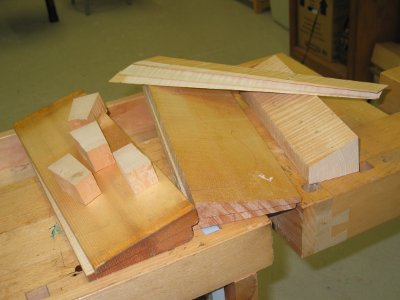
The customer requested a new violin made to my Strad pattern. Together, we went through my wood supply and picked out the wood for the instrument. The spruce is Italian and the maple is Bosnian. Both pieces are over 10 years old. The blocks are some very straight grained Sitka spruce that I found in Canada.
The selected wood
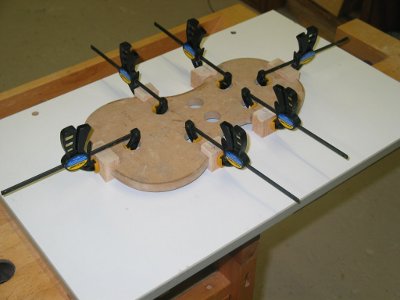
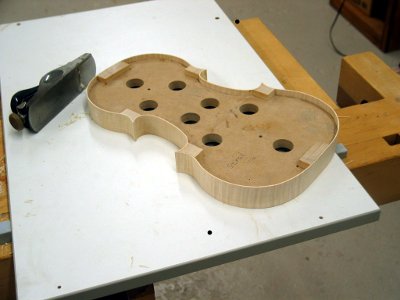
The first step is to trim the blocks to size and spot glue them to the form.
The Blocks glued to the form
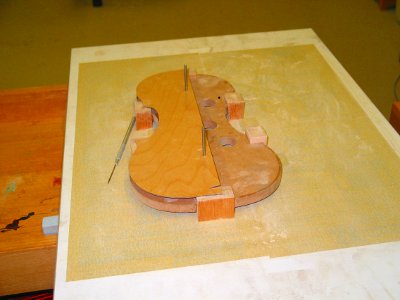
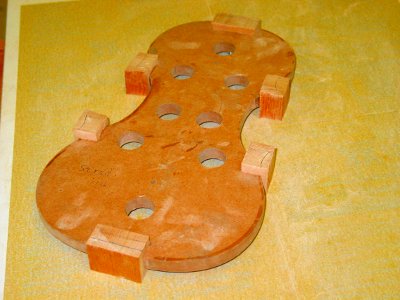
The next step is to draw the outline on the blocks.
Tracing the outline on the ribsBlocks ready to be trimmed.
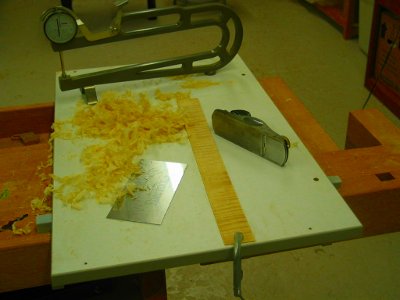
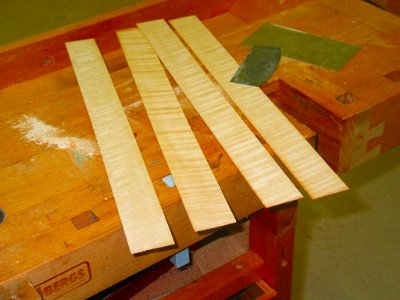
Next, we have to plane and scrape the rib material down to a thickness of about 1.2 mm.
Planning and scraping ribsfinished rib material
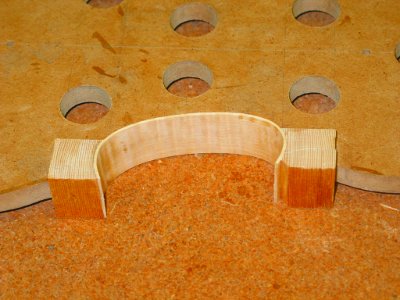
Finally, we then trim the blocks to accept c-bout ribs, bend the ribs to shape and glue them in place.
Finished c-bout ribs
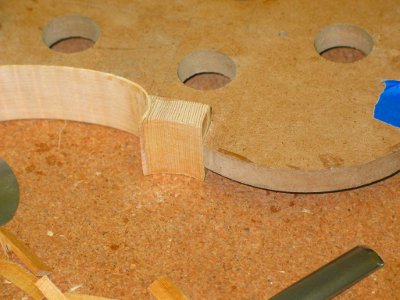
Now we trim the other blocks to accept the bent ribs.